Back to School Kindergarten Counting 1–10
The transition from summer break to the structured environment of a classroom can be jarring for young learners. Back to School Kindergarten Counting 1–10 serves as a vital bridge, transforming abstract mathematical concepts into tangible, hands-on experiences. This resource is not merely a collection of pages; it is a strategic tool designed to ignite early math skills through playful engagement. For educators and parents navigating the complexities of early childhood education, finding materials that balance cognitive development with motor skill refinement is essential.
These counting worksheets are specifically crafted for Preschool, Pre-K, and Kindergarten students who thrive on active participation rather than passive listening. By integrating cut-and-paste mechanics with number recognition tasks, the pack addresses multiple developmental domains simultaneously. The focus remains firmly on numbers 1 through 10, ensuring that children build a solid foundation before moving on to more complex arithmetic operations later in their academic journey.
Why Hands-On Learning Matters in Early Math
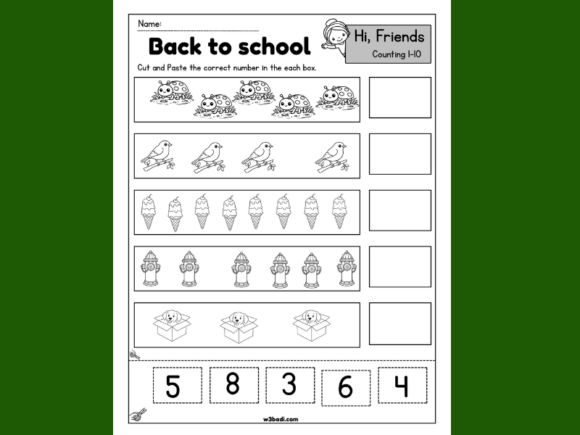
Traditional rote memorization often fails to stick with young minds. Children learn best when they can manipulate objects and see immediate results. The Back to School Kindergarten Counting 1–10 worksheets leverage this principle by requiring students to physically count objects, cut out the corresponding numeral, and paste it in the correct spot. This process reinforces one-to-one correspondence—a critical concept where a child understands that each object counted represents exactly one number.
Beyond the mathematics, these activities are excellent for developing fine motor skills. The act of cutting along lines strengthens the small muscles in the hand, which is directly linked to writing readiness. When a child successfully matches a quantity to its symbol, they gain confidence in their ability to solve problems independently. This sense of accomplishment is crucial during the "back to school" adjustment period, helping to reduce anxiety and foster a positive attitude toward learning.
Key Features That Drive Engagement
The design of these resources prioritizes both functionality and aesthetics. Each worksheet features cute, kid-friendly illustrations that capture attention without causing visual clutter. The black-and-white format ensures that printing costs remain low while allowing for creative customization if teachers wish to add color. Here is what makes this specific math pack stand out:
- Structured Practice: Ten distinct worksheets provide ample repetition without becoming monotonous, covering every number from 1 to 10.
- Cognitive Challenges: Activities require visual discrimination, forcing students to distinguish between similar shapes or quantities before making a selection.
- Scissor Skills Integration: Cutting and pasting are embedded naturally into the lesson, turning a routine task into an educational opportunity.
- No-Prep Convenience: As printable PDFs, these sheets are ready to use immediately, saving valuable planning time for busy professionals.
Practical Applications Across Educational Settings
The versatility of Back to School Kindergarten Counting 1–10 makes it suitable for a wide array of environments. Whether you are managing a large public school class, running a small homeschool co-op, or providing specialized instruction in special education, these tools adapt to your needs seamlessly.
In a traditional classroom setting, these worksheets are ideal for math centers. Teachers can rotate groups of students through stations, allowing for differentiated instruction where some students work on counting while others engage in literacy or art. Because the activity requires independent execution, it frees up the teacher to assist other students who may need one-on-one guidance. Furthermore, these sheets serve as excellent morning work, settling students into the day's routine while quietly assessing their prior knowledge.
For homeschoolers and private tutors, the value lies in the flexibility. The "no-prep" nature means lessons can be planned in minutes, yet the content remains rigorous enough to meet curriculum standards. Parents can use these pages during quiet work times or as a supplement to digital learning apps, offering a necessary screen-free alternative that still promotes cognitive growth.
Strategic Use Cases for Educators and Creators
Professionals in the education sector often look for resources that offer high utility with minimal overhead. These counting worksheets fit that criteria perfectly. Consider how a substitute teacher might utilize this pack: in a situation where the regular instructor is absent, a sub plan that includes self-directed, engaging activities ensures continuity of learning without requiring extensive explanation.
Similarly, for creators and entrepreneurs building educational marketplaces or blogs, this type of content is highly shareable. It addresses a universal pain point—the need for effective, low-cost math practice—making it a potential lead magnet or a featured product in a resource bundle. The clear alignment with early learning goals (number recognition, counting, scissor skills) makes it easy to market to a targeted audience of concerned parents and dedicated teachers.
When implementing these resources, it is important to consider the pacing. While the worksheets are designed for independent work, introducing them with a whole-group demonstration helps clarify expectations. Encouraging students to check their own work after pasting the numbers fosters self-correction habits early on. Additionally, observing which numbers cause the most difficulty can provide valuable data for future lesson planning.
Building Confidence Through Interactive Design
The ultimate goal of early education is to create lifelong learners who feel capable and curious. The Back to School Kindergarten Counting 1–10 pack achieves this by breaking down intimidating subjects into manageable, fun steps. When a child sees a pile of apples and correctly identifies the number "5," then physically places the number card next to them, the abstract becomes concrete. This tactile feedback loop is powerful.
Moreover, the simplicity of the design prevents cognitive overload. Young learners do not need flashy animations or complex instructions; they need clear visuals and straightforward tasks. The clean layout of these printables supports this approach, allowing the focus to remain entirely on the numbers and the objects being counted. This clarity contributes to a smoother user experience, whether the user is a stressed parent trying to keep things organized or a teacher managing twenty energetic five-year-olds.
As schools continue to evolve, the demand for resources that blend academic rigor with developmental appropriateness will only grow. This set of worksheets represents a practical solution that respects the unique learning styles of young children. By combining the joy of crafting with the necessity of math, it turns the first weeks of school into a period of discovery rather than just a test of compliance.
Whether used for independent practice, small group instruction, or at-home reinforcement, these counting activities prove that foundational math skills can be taught with creativity and care. They are more than just paper; they are stepping stones toward a child's academic success.